
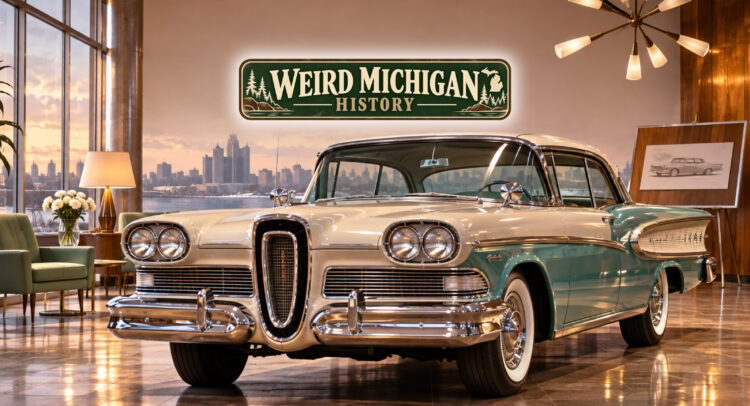
Ford Motor Company spent years developing a completely new automobile.
They researched the market.
They questioned consumers.
They hired advertising experts.
They considered thousands of possible names.
They even brought in a Pulitzer Prize-winning poet to help.
And after all that work, they eventually called the car…
Edsel.
Considering what happened next, you might wonder whether they should have gone with one of the other suggestions.
Like…
Utopian Turtletop.
Yes.
That was an actual suggestion.
Ford Needed Something New
By the mid-1950s, Ford executives believed the company had a hole in its lineup.
General Motors offered buyers a ladder of brands that allowed customers to move from Chevrolet to Pontiac, Oldsmobile, Buick and eventually Cadillac as their income increased.
Ford had Ford, Mercury and Lincoln.
The company wanted another brand to compete in the middle of the market.
Internally, the project became known simply as the E-Car — short for “Experimental Car.”
But eventually somebody was going to have to come up with an actual name.
And apparently that was harder than building the car.
Just Give Us ONE Name
Ford’s advertising agency, Foote, Cone & Belding, was asked to develop possibilities.
They produced thousands.
According to accounts of the Edsel project, the list eventually grew to more than 6,000 potential names.
When presented with the enormous collection, Edsel project manager Richard Krafve reportedly reacted with essentially:
We don’t need 6,000 names.
We need one.
Fair point.
The list was eventually narrowed down, and four names kept rising to the top:
Corsair.
Citation.
Pacer.
Ranger.
All four sounded like perfectly reasonable automobile names.
In fact, they were so reasonable that Ford eventually used all four of them as names for Edsel models.
But before that happened, Ford decided it needed some additional creative help.
Call the Poet
Someone at Ford had an unusual idea.
Why not ask a famous poet to name the car?
So the company approached Marianne Moore, one of America’s most respected poets.
Moore had won the Pulitzer Prize, National Book Award and Bollingen Prize for her poetry.
Surely she could come up with something better than the marketing department.
And she absolutely came up with names.
Lots of them.
Whether they belonged on the back of an automobile is another question.
Among Moore’s suggestions were:
Resilient Bullet
Mongoose Civique
Pastelogram
Andante con Moto
and my personal favorite…
Utopian Turtletop
Imagine that dealership commercial.
“Come test-drive the exciting new 1958 Ford Utopian Turtletop!”
I don’t know if Ford would have sold more cars.
But I’m reasonably certain nobody would have forgotten the name.
Moore’s correspondence with Ford later became famous enough that The New Yorker published it.
Unfortunately for the Turtletop, Ford executives weren’t quite ready to go that far.
And Then Someone Said “Edsel”
After months of research and thousands of suggestions, Ford’s executive committee gathered to make a decision.
The favored names included Corsair, Citation, Pacer and Ranger.
Ford chairman Ernest Breech apparently wasn’t impressed.
Eventually the group came across another name that had been floating around during the process:
Edsel.
Edsel Ford had been Henry Ford’s only son and had served as president of Ford Motor Company from 1919 until his death in 1943. He had played an enormous role in bringing style and refinement to Ford products and helped create cars including the Lincoln Continental.
According to contemporary accounts of the naming meeting, Breech essentially settled the matter:
Call it Edsel.
After thousands of suggestions, market studies and creative exercises, the new automobile would simply carry the first name of Henry Ford’s son.
Ford publicly announced the name on November 19, 1956.
Not Everyone Loved It
The reaction inside the company wasn’t universally enthusiastic.
Some of the people involved in the naming research thought “Edsel” simply didn’t sound like an automobile.
When researchers tested associations with the word, people reportedly came up with things like:
Pretzel.
Diesel.
Hard sell.
Not exactly the exciting, aspirational imagery Ford had been hoping for.
But the decision had been made.
The E-Car officially became the Edsel.
And Ford began preparing one of the biggest automobile launches in history.
Welcome to E-Day
On September 4, 1957, Ford introduced the 1958 Edsel to the public.
It was called E-Day.
Americans packed dealerships to see the mysterious new automobile Ford had been teasing for months.
The car certainly looked different.
There was the unusual vertical grille.
There was the Teletouch automatic transmission, with push buttons mounted in the center of the steering wheel.
And there were models carrying some of those names Ford had rejected for the brand itself:
Ranger.
Pacer.
Corsair.
Citation.
Ford had predicted enormous sales.
Instead, the Edsel quickly became one of the most famous commercial disappointments in American history. Sales fell far short of expectations, and production ended in November 1959.
Was the Name Really the Problem?
It’s tempting to blame everything on the word Edsel.
But the reality was much more complicated.
The car arrived during an economic recession.
Consumer tastes were shifting toward smaller cars.
Prices sometimes overlapped with established Ford and Mercury products.
Quality-control problems hurt the launch.
And that distinctive grille certainly gave comedians plenty of material.
The name probably didn’t kill the Edsel.
But once the car failed, the name became inseparable from the failure.
Today, calling something “an Edsel” can still mean an expensive idea that spectacularly didn’t work.
Which is particularly unfortunate considering Edsel Ford himself was actually one of the most influential and talented automobile executives in Ford history.
The Weird Part
Ford spent an enormous amount of time and money searching for exactly the right name.
Thousands of possibilities.
Consumer research.
Advertising agencies.
A Pulitzer Prize-winning poet.
And after all of that…
they named it after the boss’s father.
Sometimes the simplest answer really is sitting right in front of you.
Although I still can’t stop imagining the alternate universe where the decision went differently.
Somewhere in that universe, collectors are gathering at car shows and proudly saying:
“Yep. She’s a 1958 Utopian Turtletop.”
And honestly?
I kind of wish we lived there.
