

Imagine standing along the banks of the Grand River in downtown Grand Rapids on a summer day in 1883.
At first, everything seemed normal.
Then you heard it.
A distant roar.
Not thunder.
Not a train.
Millions of pounds of logs racing downstream.
During the spring and summer of the late 1800s, Michigan’s rivers served as highways for the state’s booming lumber industry. After trees were cut in the northern forests, they were floated downstream to sawmills waiting farther south.
Usually, the system worked.
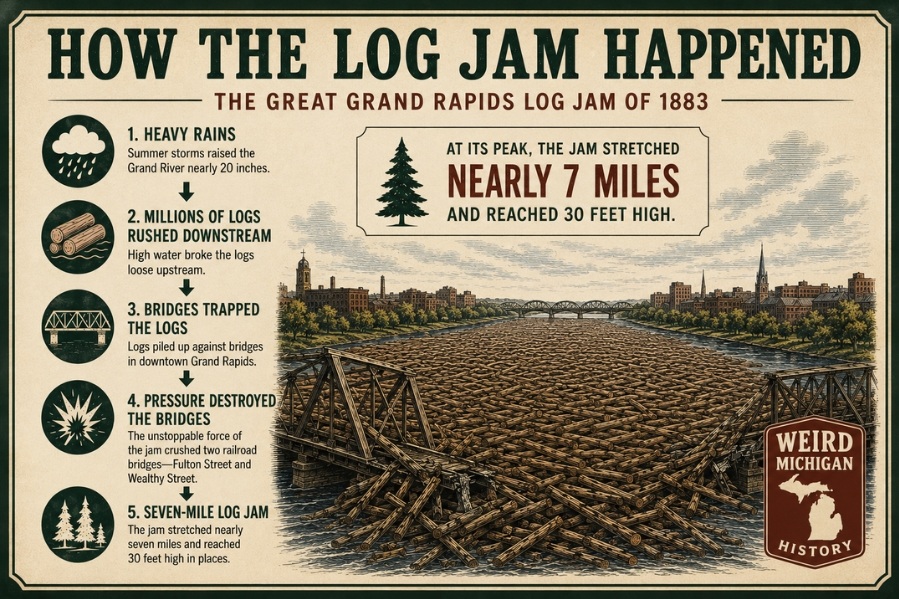
But in July 1883, heavy rains caused the Grand River to rise nearly 20 inches.
That extra water unleashed one of the largest log jams in American history.
An estimated 150 million board feet of timber broke loose and surged toward downtown Grand Rapids.
When the logs reached bridges and narrow sections of the river…
Everything stopped.
The Weird Part
The pileup became almost impossible to imagine.
Logs stacked nearly 30 feet high.
The jam stretched for approximately seven miles along the Grand River.
The pressure became so great that two railroad bridges, at Fulton Street and Wealthy Street, were crushed and swept away.
For days, the river wasn’t really a river anymore.
It was a giant floating wall of timber.
Workers scrambled to break the jam apart before more destruction followed.
It became one of the largest log jams ever recorded in the United States.
Michigan Tie-In
Today, it’s hard to picture downtown Grand Rapids buried beneath mountains of floating logs.
But in the late 1800s, lumber was king.
Michigan led the nation in timber production, and rivers like the Grand carried millions of logs every year from the northern forests to sawmills downstream.
The same river many people fish today once looked more like a moving forest.
Final Thought
Traffic jams are frustrating.
Log jams…
Used to destroy bridges.
It’s one of those moments in Michigan history that’s almost impossible to picture today.
And yet, it really happened.
.
